Can Teaching Voters How Election Technology Works Raise Their Trust
A forthcoming survey experiment by Texas State University researchers tests whether technical education about election systems, together with a person's readiness to use technology, changes trust in elections. Results are not yet published.
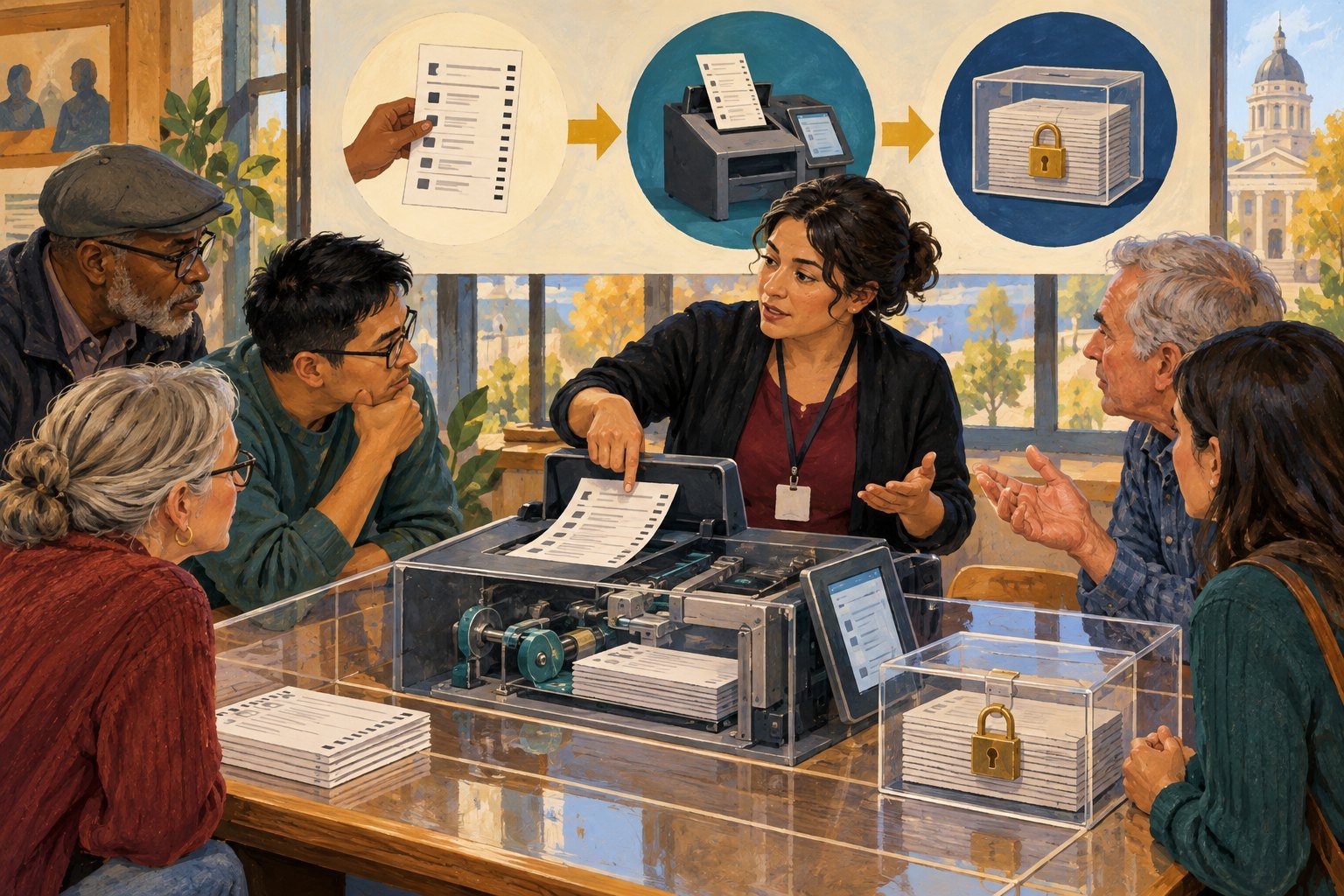
Public confidence in elections has become a persistent policy problem in the United States. Much of the doubt centers on the machines and software that record and count votes. A forthcoming paper by three Texas State University researchers asks a direct question. If people are taught how that technology works, do they trust elections more?
The authors are Lauren M. Rowlands, Assistant Professor in the Department of Political Science at Texas State University; Ju Long, Professor of Information Systems and Analytics in the McCoy College of Business; and Garry White, a longtime Associate Professor of Computer Information Systems and Quantitative Methods at Texas State who does not appear in the current department directory.
What is known about the study
The paper has not yet been published, and no abstract is available. It is listed as forthcoming on the faculty profiles of Long and Rowlands. What follows is based on the title alone.
The title describes a survey experiment. In this design, respondents are randomly assigned to receive different information, here a technical education treatment about election technology, and their trust in elections is then compared across groups. Random assignment lets the researchers attribute differences in trust to the treatment rather than to who chose to read it.
The title also names technology readiness. This is a measure of how comfortable and confident a person is with new technology. Its inclusion suggests the authors expect the education treatment to work differently for people who are at ease with technology than for those who are not.
Related published work
Two of the authors have published the groundwork. In 2025, White and Long published a research proposal in the Cybersecurity Pedagogy and Practice Journal titled “Education Impact on Trust in Election Technology & Security.” It proposed testing whether education changes trust in election security and technology, using established models of technology acceptance and a before-and-after survey of eligible voters. The forthcoming paper appears to carry that proposal into a completed experiment, with a political scientist added to the team.
Why it matters
Election officials spend heavily on public information campaigns. Prior research from other groups has found that explaining election safeguards can raise confidence across party lines. This study narrows the question to the technology itself and to whether the effect depends on the audience’s technical readiness. If the answer is yes, outreach could be tailored, with deeper technical material for some audiences and simpler assurances for others.
Because results are not yet available, no findings are reported here. This page should be updated when the paper appears.
This summary is based on the paper’s title and the authors’ faculty profile listings. No abstract or full text was available.
What it means for managers
- Watch this space. The paper is listed as forthcoming on the authors' Texas State faculty profiles, and no published version, venue, or abstract has been located yet.
- The research question is practical. If a short technical explanation of how voting systems work raises trust, election offices have a low-cost tool to deploy.
- Technology readiness is part of the design. The title signals that a voter's comfort with technology may shape how much a technical explanation helps.
Rowlands, L. M., Long, J., & White, G. (n.d.). Enhancing election trust through technology understanding: A survey experiment on technical education and technology readiness. Unpublished manuscript, listed as forthcoming.
Related

A Tuberculosis Model That Works in Both Continuous and Discrete Time
Researchers built a single tuberculosis model that can run on continuous time or on fixed reporting intervals. The size of the time step changes what the model predicts, which matters for anyone using case data to plan.
Dincer Konur
A Weekly Model Predicts Jump Readiness Across a Basketball Season
Practice workload, lifting volume, stress, and the prior week's jump explained 71 percent of the weekly change in maximum vertical jump for Division 1 women's basketball players. Jump height drifted down as the season went on, a cue to cut load.
Rasim M. Musal
A Better Way to Check Regression Models That Predict Counts and Categories
Analysts who model yes-or-no outcomes, ratings, or counts have lacked good tools to check whether the model fits. A new framework replaces the usual single-number residual with a function, and yields plots that reveal missing variables, interactions, and other misspecifications.
Zewei Lin