When Customers and Employees Think Differently, Both Sides Lose. There Is a Fix
As many as one in five people may be neurodivergent, so service encounters between people who communicate differently are common. A new commentary proposes neuroconvergence as a way to close those gaps and keep the creativity they can bring.
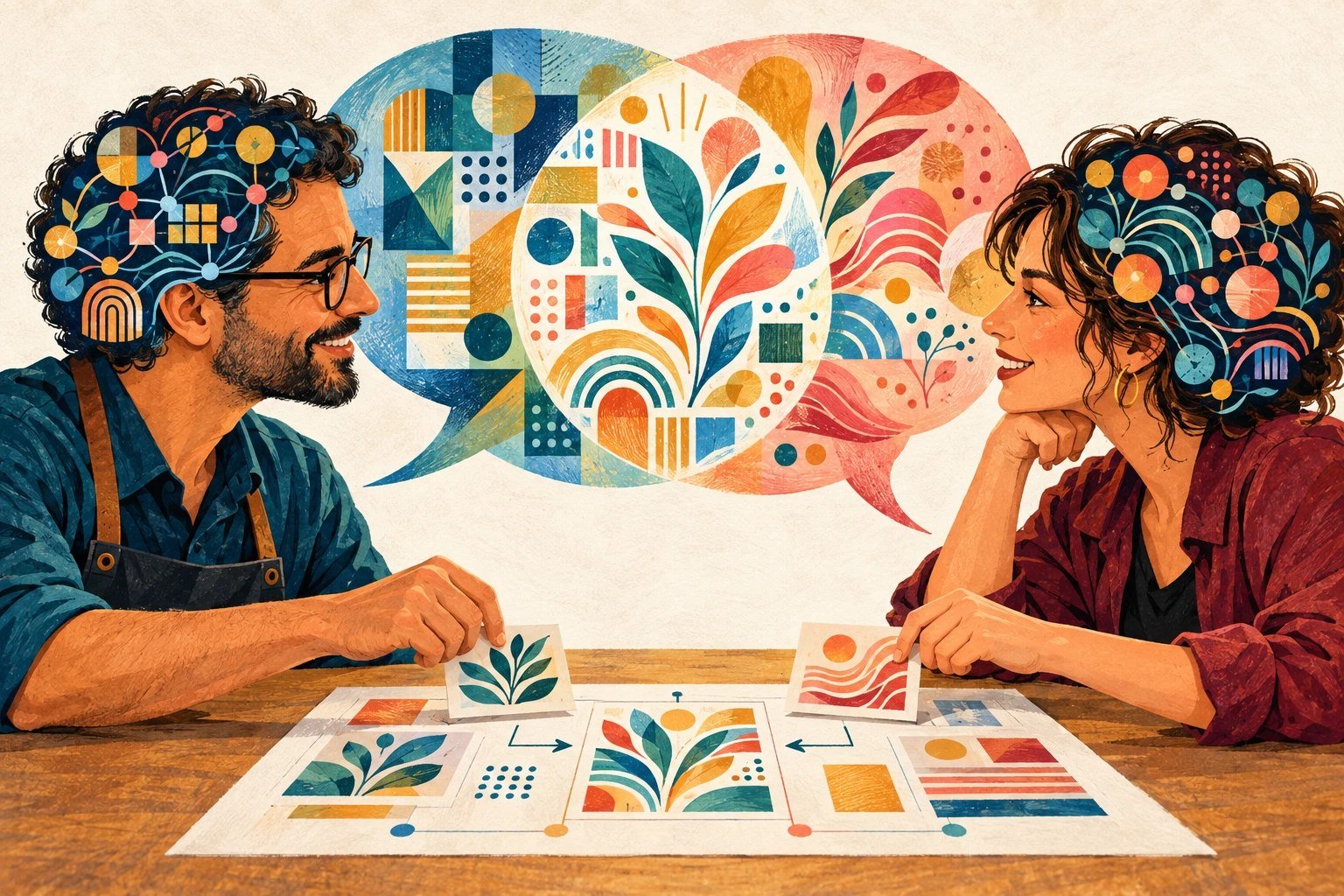
A designer at a branding agency produces highly original concepts. The designer prefers to work alone and tends to deliver at the last minute. The client, a restaurant chain, wants to give feedback at every stage and expects work well ahead of the deadline. The ideas are strong and fit the client’s goals. The client discounts them anyway because of how and when they arrived, then hires a faster, less original agency. The designer is reprimanded for losing the account.
That scenario opens a new commentary by Nancy J. Sirianni, associate professor of marketing, with Kathryn Greenslade of the University of New Hampshire, Gamze Koseoglu of the University of Melbourne, Josephine Go Jefferies of Newcastle University, and Cinthia B. Satornino of Babson College. Nobody in the story did poor work. The two sides needed different things from the exchange, and neither need was met.
The assumption that fails
Firms and customers tend to assume that a service exchange follows shared rules, shared social norms, and a shared emotional rhythm. The authors argue that this assumption often does not hold. When a customer and an employee differ in how they communicate and what they expect from an interaction, both can leave worse off.
The commentary frames this through neurodiversity, the natural variation in how people think, learn, and process information. Everyone is part of that variation. A person is described as neurodivergent when their own cognitive abilities differ from one another by an unusually wide margin, with some much stronger or weaker than is typical. A neurotypical person has a more even profile.
Those differences cut both ways. They can bring stronger innovation, accuracy, and problem solving. They can also come with challenges such as difficulty tracking time, sensitivity to light and sound, strain in social interaction, anxiety, and burnout from masking, which is the effort of hiding differences to fit in.
Why it matters at the front line
The commentary cites an estimate that 15% to 20% of people worldwide may be neurodivergent. At that scale, encounters between people of different neurotypes are an everyday part of service work. They are not an edge case.
The authors propose neuroconvergence as a strategy for reducing these communication mismatches while keeping the creative value that different ways of thinking bring. Their argument is that firms can benefit from these differences by designing customer experiences with every neurotype in mind.
The commentary also sets out questions for future research. These cover how institutions, markets, workforce systems, and AI governance could put neuroconvergence into practice at scale, with accessible communication treated as a driver of fair and creative customer experience.
What it means for managers
- Do not assume every customer and employee communicates the same way. Frontline exchanges are built on unwritten norms that not everyone shares.
- Count the cost of a mismatch. It can lose the customer, waste original work, and penalize the employee, all at once.
- Design customer experiences with all neurotypes in mind. The differences that cause friction can also bring innovation, accuracy, and problem solving.
Sirianni, N. J., Greenslade, K., Koseoglu, G., Go Jefferies, J., & Satornino, C. B. (2026). Neuroconvergence: An untapped strategy for reducing communication mismatches and enhancing creativity in frontline encounters. Journal of Public Policy & Marketing, 45(3), 231-234. 10.1177/07439156261435454
Related
What Happens When Ads Say They Were Made With AI
A new study led by a McCoy College marketing professor tests how disclosing that an ad was generated by AI affects consumer attitudes, purchase intent, and social media engagement. The abstract was not available when this summary was written, so results are not reported here.
Rick Wilson
When a Health App Says You Are Safe, You May Take More Risks
AI wearables and health apps are sold on safety. A new framework explains why that reassurance can lead people to skip the doctor, push past their limits, and rely on a device to catch what it cannot see.
Sidney T. Anderson
Celebrity Brands Lift Stores When the Star, Product, and Shelf Fit
Celebrity brands make a store more attractive when the celebrity fits the product category, fits the store, and fits the store's other brands. That attraction feeds store equity and loyalty, and the effects differ for shoppers who idolize celebrities.
Vishag Badrinarayanan, Enrique P. Becerra, Jeremy J. Sierra