Betting Markets Priced Trump News Fast. The Stock Market Took Days
During the 2024 election, betting odds on a Trump win and the stock of his media company tracked each other closely. The odds adjusted at once. The stock lagged by several days, a sign that investors process political news slowly.
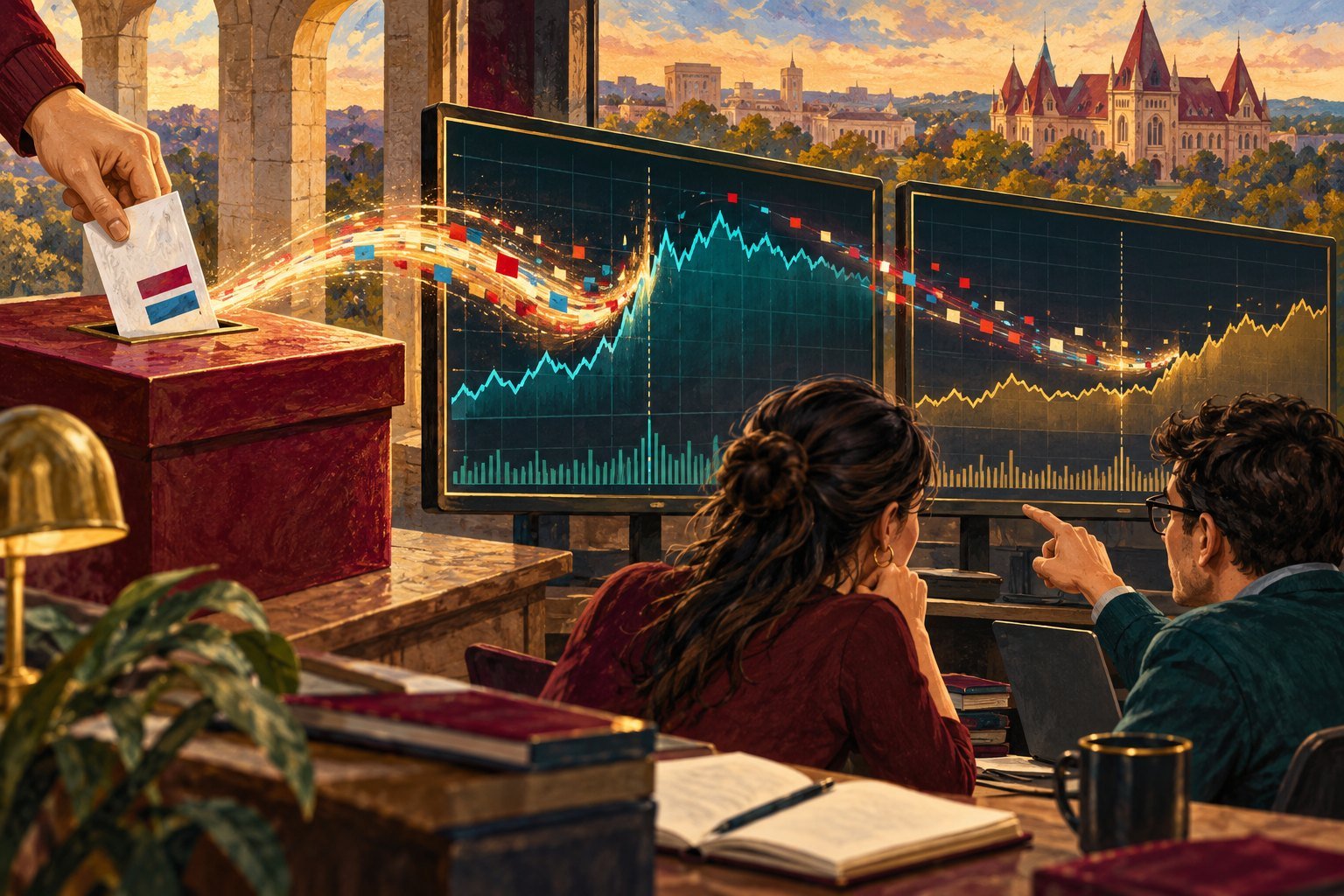
How quickly do investors price political news? The 2024 U.S. presidential election offered an unusual way to find out. One candidate, Donald Trump, was also the controlling shareholder of a publicly traded company, Trump Media & Technology Group, which trades under the ticker DJT. A study by two McCoy College of Business faculty members, published in Finance Research Letters, uses that setting to compare how betting markets and the stock market handled the same information.
The authors are Matthew James Flynn and Augustine Tarkom, both assistant professors in the Department of Finance and Economics.
The study
The researchers collected daily odds on a Trump victory from election betting markets. They paired those odds with daily returns on DJT stock. Because the company’s fortunes were tied to its founder’s political prospects, the stock offered a direct market read on the election.
They then tested the relationship between the two series in several ways. The abstract describes robust evidence of interdependence across multiple empirical specifications. The published highlights add that the authors used an instrumental variable approach, a statistical method for isolating cause from effect, to show that shifts in election odds drove DJT returns rather than the reverse.
What the researchers found
Both markets reacted strongly to news about Trump. The difference was speed.
Betting markets incorporated new political information right away. That is what an efficient market is supposed to do. The stock market did not keep pace. DJT’s price adjusted with a systematic delay, taking several trading days to fully reflect a change in the odds. The highlights put the lag at three to five days.
The authors interpret the lag as evidence of information processing frictions. Investors saw the same news the bettors saw, but it took time for that news to be reflected in the stock price. The highlights also point to overnight and weekend returns as evidence that limited attention played a role. When markets were closed and traders were not watching, political developments piled up and were priced later.
The paper’s main contribution is the comparison itself. Two markets, one stream of political information, and a measurable difference in how fast each one used it.
What it means for investors and policymakers
For investors, the result is a reminder that market efficiency is not uniform. Prediction markets, which are small and focused on one question, can process a specific kind of news faster than a broad stock market. When a stock’s value depends heavily on a political outcome, the gap between the two can persist for days.
For policymakers and market observers, the study shows how a single company can become a real-time gauge of political sentiment. It also shows the limits of that gauge. The stock lagged, so anyone reading DJT as a live election indicator was reading old news.
The setting will not repeat often. Few candidates own a listed company. But the method, matching a prediction market to an asset whose value hinges on the same event, can be applied wherever such pairs exist.
This summary is based on the paper’s abstract. The full article reports the data, methods, and detailed results.
What it means for managers
- Political news reaches asset prices with a delay. Betting markets absorbed new information about the election immediately. The linked stock needed several trading days to catch up.
- A candidate with a listed company is a rare natural experiment. DJT's price gave a direct, daily read on how investors valued election odds.
- For investors, the gap between prediction markets and stock prices was a measurable signal of unprocessed information. For policymakers, it shows that even widely watched political events face frictions in financial markets.
Flynn, M., & Tarkom, A. (2025). How do financial markets price political uncertainty? Evidence from the 2024 United States presidential election. Finance Research Letters, 75, 106879. 10.1016/j.frl.2025.106879
Related

How Volatility Travels Between U.S. Housing Markets and Where the Risk Builds
A forthcoming Journal of Empirical Finance paper co-authored by McCoy College Dean Sanjay Ramchander studies how price volatility spreads across U.S. housing markets and what that means for systemic risk. It applies several methods to trace the transmission.
Sanjay Ramchander
Social Media Reliance Tilts Investors Toward Short-Term Goals at Every Age
Investors who lean on social media for financial information report stronger short-term motives and weaker long-term ones, in every age group. Overconfidence deepens the drift away from long-term thinking, and the pattern holds across two survey waves.
Augustine Tarkom, Ken Moon, Vance Lesseig
Cutting Crypto Off From Banks Slashed Trading in India, and the Rebound Was Slow
India's 2018 order barring banks from serving crypto businesses caused a sharp, immediate drop in retail crypto activity. After the Supreme Court lifted it in 2020, activity recovered only gradually, while bank accounts and deposits rose.
Matthew James Flynn, Ishitha Kumar