Where People Gamble, They Also Bet on Stock Options
Retail interest in stock options runs higher in states with a strong gambling culture, and it tilts toward long-shot contracts. The same states show more short-term borrowing and more missed payments.
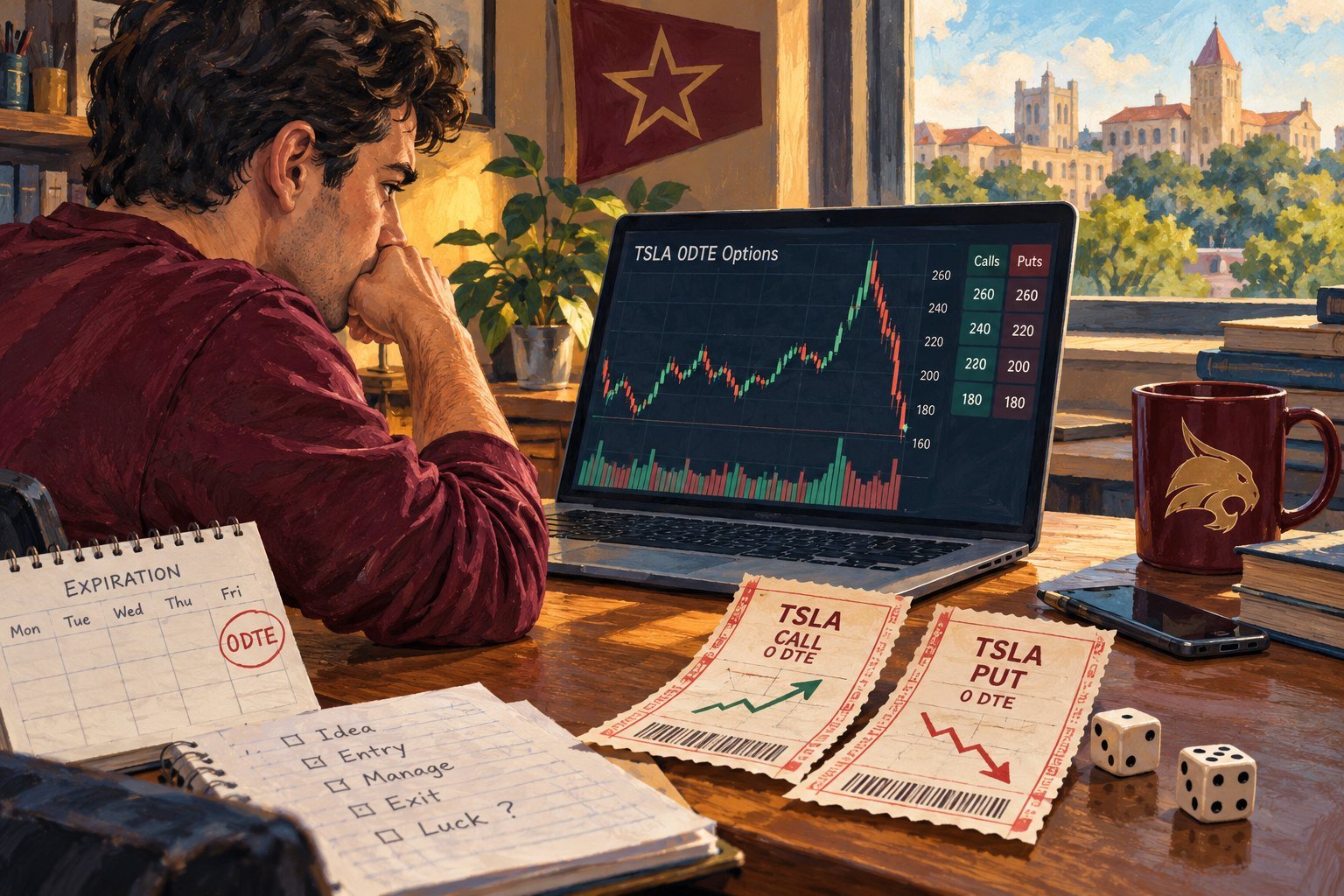
Retail trading in stock options has grown fast. A new study from three McCoy College of Business faculty members asks a blunt question about that growth: are many of these traders gambling? The answer, published in the Journal of Financial Markets, is that a state’s gambling culture is a strong predictor of how much its residents pay attention to options, and of which options they favor.
The authors are Matthew James Flynn and Yifan Liu, both assistant professors, and Ivilina T. Popova, professor, all in the Department of Finance and Economics.
The study
The researchers needed a way to see retail interest in options across the country. They built a search volume index from Google data. The index measures how intensely people in each U.S. state search for option-related terms. Spikes in the index mark moments when public interest surges, such as around a company’s earnings report.
They paired this index with measures of each state’s gambling propensity. They also used shocks that change the gambling environment, in particular the legalization of sports betting in some states. That let them test whether options and legal betting compete for the same dollars.
What the researchers found
Option attention is higher in states with a stronger gambling culture. The gap is widest around salient events such as earnings announcements, when a stock can jump or fall sharply in a day.
The pattern looks like trading, not idle curiosity. Gambling-related searches forecast later searches for options, and option search intensity rises with brokerage-related searches. In other words, attention appears to carry through to accounts and orders.
The contracts that draw the most interest in high-gambling states are lottery-like. They are out of the money, meaning the stock must make a large price change before the option pays anything. They expire soon. And they carry high implied volatility, meaning the market expects big swings. These are contracts with a small chance of a large payoff, which is the profile of a lottery ticket.
Legal sports betting changes the picture. When a state legalizes sports betting, attention to options falls. The authors read this as substitution: some of the same people who would speculate in options are now betting on games instead.
The study also connects option attention to household finances. In gambling-prone states, elevated option attention goes with higher short-term borrowing and higher delinquency rates. The authors are careful on this point. The data are at the state level, so the study shows an association, not proof that any given household borrowed to trade.
What it means for brokers, regulators, and investors
For brokers, the findings suggest that a slice of retail option demand is driven by the appetite for a bet rather than a view on a company. Product design, defaults, and warnings matter more for that group than for hedgers.
For regulators, the substitution result is useful. Options and sports betting appear to be, for some people, two doors to the same room. Policy that treats them in isolation may miss the shift between them. The link to consumer debt argues for watching retail options through a consumer-protection lens as well as a market-quality lens.
For individual investors, the message is simple. Short-dated, far out-of-the-money options are priced like lottery tickets for a reason. Treating them as a bet is honest. Treating them as an investment is not.
This summary is based on the paper’s abstract. The full article reports the data, methods, and detailed results.
What it means for managers
- Gambling culture predicts speculative option interest. Gambling-related searches in a state forecast searches for options and trading-related activity there.
- The interest concentrates in lottery-like contracts. Out-of-the-money, short-dated, high-volatility options draw the most attention in high-gambling states.
- Legal sports betting pulls some of that attention away, and high option attention goes together with more short-term debt and delinquency. Brokers and regulators should treat retail options as a consumer-protection issue, not just a market-structure one.
Flynn, M., Liu, Y., & Popova, I. (2026). Do retail traders gamble on stock options? Journal of Financial Markets, 101062. 10.1016/j.finmar.2026.101062
Related

How Volatility Travels Between U.S. Housing Markets and Where the Risk Builds
A forthcoming Journal of Empirical Finance paper co-authored by McCoy College Dean Sanjay Ramchander studies how price volatility spreads across U.S. housing markets and what that means for systemic risk. It applies several methods to trace the transmission.
Sanjay Ramchander
Social Media Reliance Tilts Investors Toward Short-Term Goals at Every Age
Investors who lean on social media for financial information report stronger short-term motives and weaker long-term ones, in every age group. Overconfidence deepens the drift away from long-term thinking, and the pattern holds across two survey waves.
Augustine Tarkom, Ken Moon, Vance Lesseig
Cutting Crypto Off From Banks Slashed Trading in India, and the Rebound Was Slow
India's 2018 order barring banks from serving crypto businesses caused a sharp, immediate drop in retail crypto activity. After the Supreme Court lifted it in 2020, activity recovered only gradually, while bank accounts and deposits rose.
Matthew James Flynn, Ishitha Kumar